
Community Pool Renewal
Reimagining a much-loved community pool through strategic design, heritage, and renewal.
Client: City of Casey
Location: Victoria, Australia
Type: Community / Recreation
Status: Under construction
Scope: Renewal
“
Steven’s strong advocacy for design excellence, problem-solving skills, and commitment to quality were key to achieving successful outcomes.
Yan Zhao
Senior Landscape Architect
Yarra Ranges Council
The Project
-
We led the strategic review of the project brief and coordinated a complex group of client, user and stakeholder interests through an inclusive design process.
Through this process, we tested the project's requirements against the existing facility and identified opportunities to achieve the desired outcomes without relying on the originally proposed extension.
-
We developed a renewal strategy that works within and strengthens the existing building, transforming its architectural identity while retaining the qualities that make the pool significant to its community.
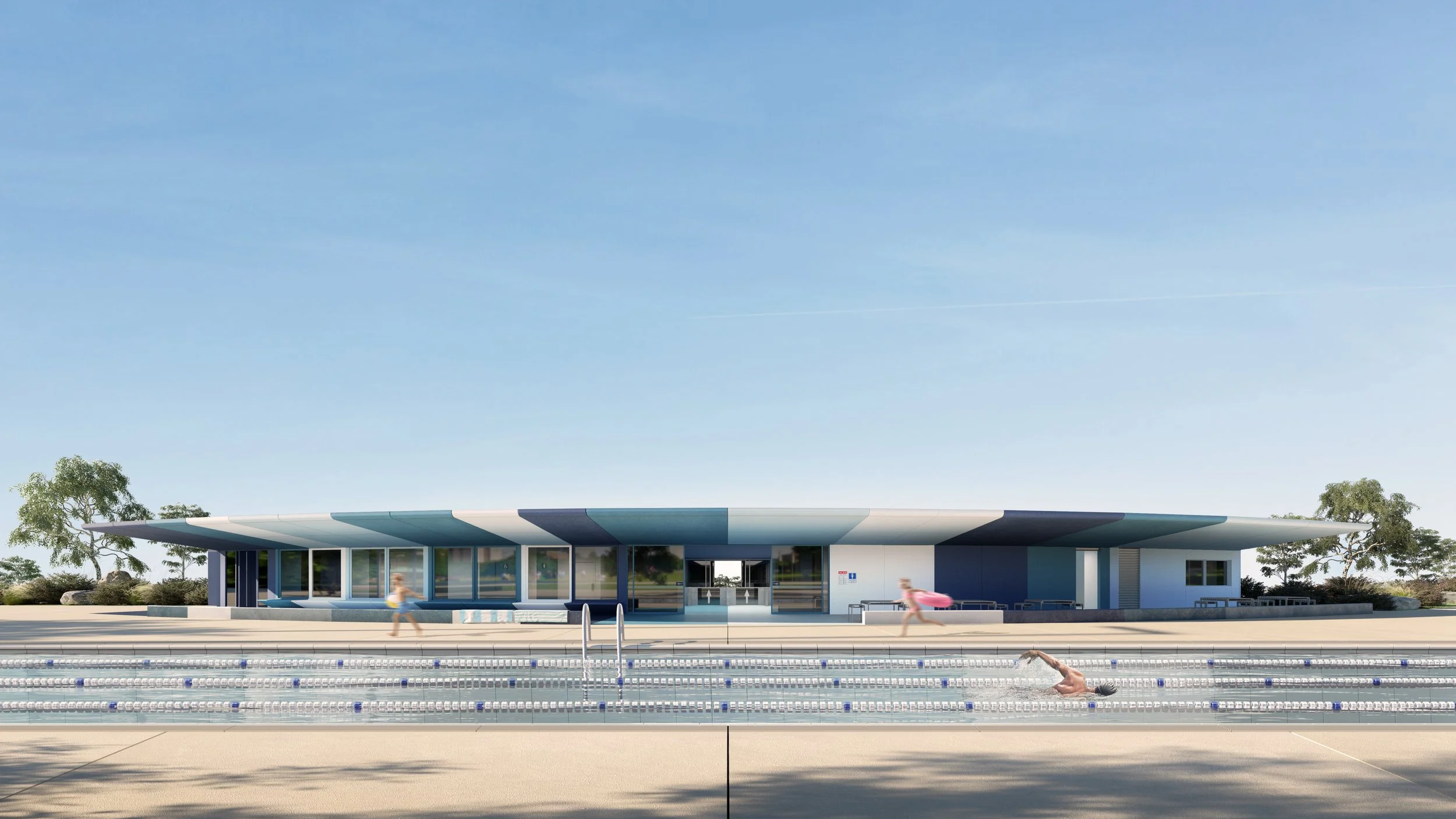
The design draws on the building's radial geometry and history of swimming carnivals to establish a distinctive architectural character, conceived as a contemporary Carnival Gem within the existing civic landscape.
-
The pool is more than a recreation facility. It is a place of memory, gathering and community identity.
The renewal aims to strengthen this role by improving the experience of swimmers, spectators and the broader community while respecting the site's history and continuing its role as a place for collective life.
-
The original brief called for an extension to the existing facility. Our review questioned whether additional building area was necessary to achieve the project's objectives.
By testing the existing building's capacity, we identified opportunities to reorganise and optimise the existing footprint rather than extend it.
This approach reduced the scope of new construction while allowing the project to address operational requirements, accessibility, public safety and the long-term renewal of the facility.
Extensive stakeholder engagement then helped refine the design and build consensus around the proposed direction.
-
$15M+ in approved funding: The project strategy supported more than $15 million in approved funding, including $7.4 million from the Federal Government.
Existing building retained: Reconsidering the original extension brief created an opportunity to optimise the existing building rather than rely on substantial new construction.
Stakeholder alignment: The design was developed through extensive consultation with stakeholders and the community, building consensus around the renewal strategy.
Delivery: The project was developed through design and documentation stages to support implementation.
-
Client: City of Casey
Location: Victoria, Australia
Type: Community / Recreation
Scope: Architecture / Renewal
Status: Under Construction
Traditional Land Owners: Bunurong/Boon Wurrung people of the Kulin Nation
-
Steven Chu (Director & Project Lead)
Alina Walizade
Ryan Poppins
Wensen Zhang -
Designed and Delivered by Artefact Director Steven Chu as Director and Principal Architect of Programmed Building Services. Moral Rights Reserved under The Architects Act 1991 by The Architect Steven Chu. All imagery shown on this website is Copyright, All Rights Reserved, and produced by Artefact Architects.
$15M+
Approved funding
$7.4M
Federal Government contribution
Adaptive Reuse
Renewal of existing building rather than wholesale replacement.
Community
A much-loved civic recreation facility.
Design
The renewal of the pool began with a simple question: did the existing building really need to be extended to achieve the project's objectives?
Rather than accepting the original brief as fixed, we examined how the existing facility could be reconfigured and renewed to better serve its community. This led to a strategy that prioritised the value already embedded in the building, while addressing its operational, accessibility and functional requirements.
The design emerged from this process of questioning, retaining and reimagining.
Challenging the Brief
The original brief proposed an extension to accommodate the required improvements. Our review challenged this assumption, asking whether the existing building could instead be optimised to achieve the same objectives.
By reconsidering the organisation of the existing facility, we identified opportunities to improve circulation, accessibility, functionality and the relationship between the pool and its supporting spaces without relying on substantial new construction.
This approach reduced the need for additional building area while allowing greater investment in the renewal of the existing community asset.
The Carnival Gem
The architectural concept draws from the character and history of the pool itself.
Swimming carnivals are moments of collective energy: competition, celebration, spectatorship and community brought together around the water. The design translates this character into a renewed architectural identity, using the existing radial geometry of the building as its generator.
We describe this idea as the Carnival Gem: a distinctive civic building shaped by the collective memory and energy of the swimming pool.
The radial geometry informs the organisation of spaces, movement through the building and the expression of the renewed architecture. Rather than imposing an entirely new form, the design reveals and strengthens qualities already present within the existing building.
Working with What Exists
The existing pool carries decades of community memory. Its significance is not only architectural, but embedded in the experiences of the people who have grown up around it.
The renewal therefore seeks to preserve continuity while allowing the facility to evolve. Important elements of the existing building are retained and reinterpreted, while new interventions improve its performance, accessibility and contemporary use.
The result is neither preservation for its own sake nor replacement with something entirely new. It is a process of renewal through transformation, allowing a familiar community landmark to continue its story into the future.
-
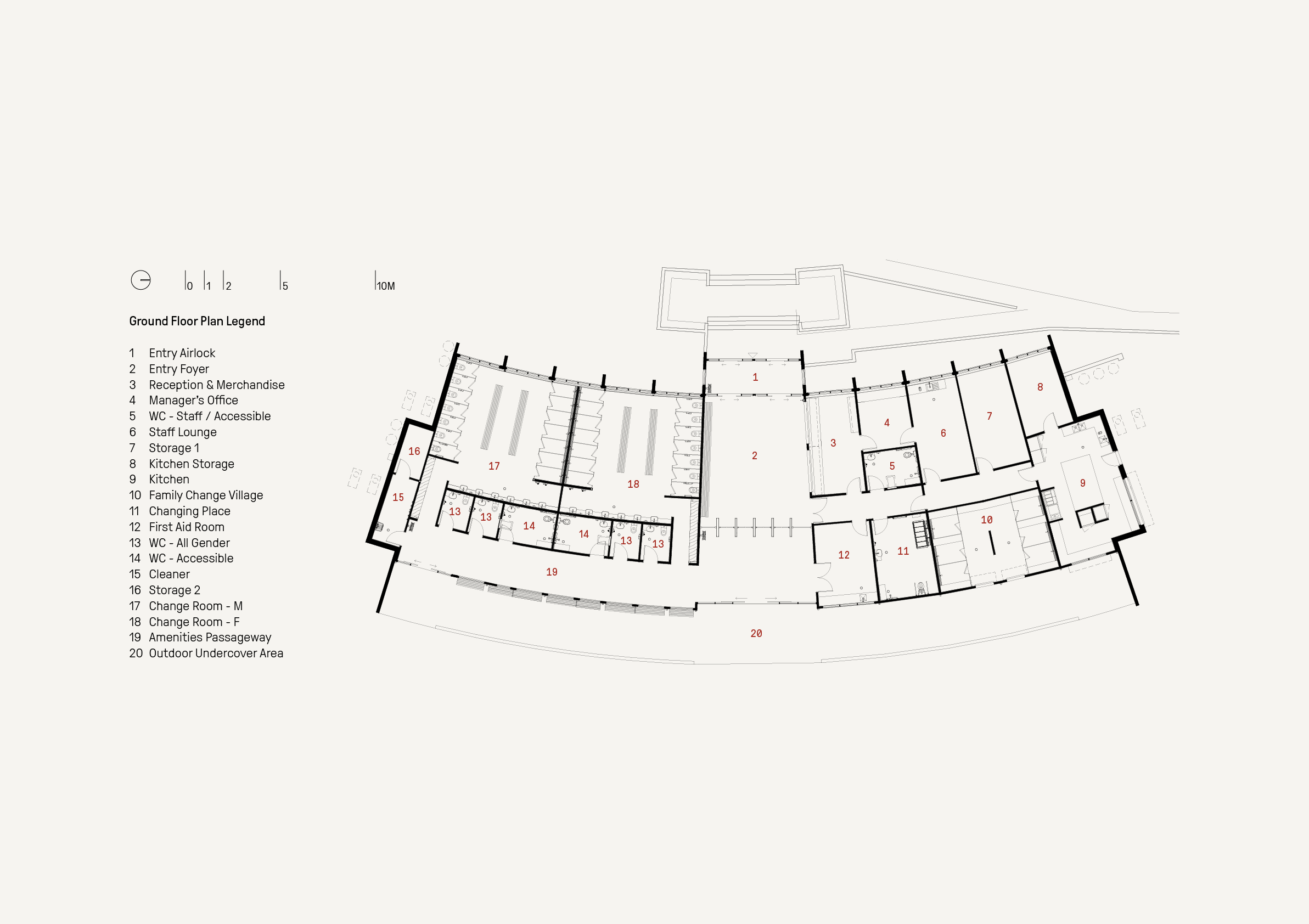
![Floor plan of a building's ground level showing various rooms such as entry airlock, foyer, reception, manager's office, restrooms, storage areas, kitchen, change rooms, first aid, outdoor area, and passageways, with a legend on the left.]()
Working within the existing footprint: The renewed plan reorganises the existing facility around clearer circulation, improved accessibility and more effective connections between the pool and supporting spaces.
-
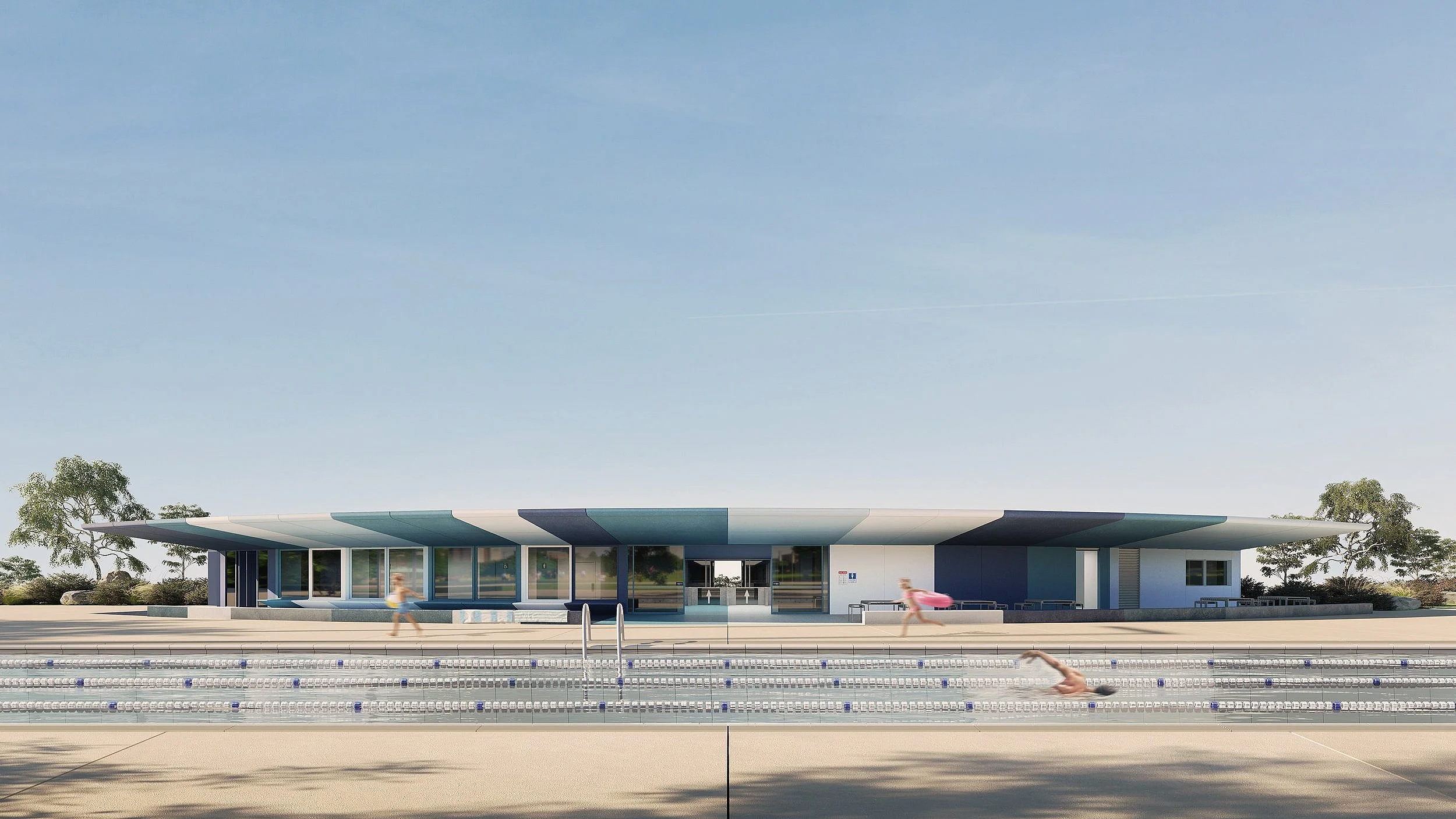
![Community Pool Renewal Exterior View]()
Continuity and renewal: The design retains the architectural character and collective memory of the existing facility while introducing a contemporary identity.
-
![Interior view of the community pool renewal]()
Materials are selected for the demands of an aquatic environment while contributing to a distinctive civic identity.
Robust surfaces are paired with moments of colour, light and texture to create an atmosphere that feels both durable and celebratory.

Sound of Rain
Family & Community Centre
Community Pool Renewal
Nurturing Kindergarten Rooms
The Lost Garden